
Bussaco • Portugal
Palace Hotel Bussaco: a Portuguese palace, a forest and time to slow down
BEST TRAVELS •
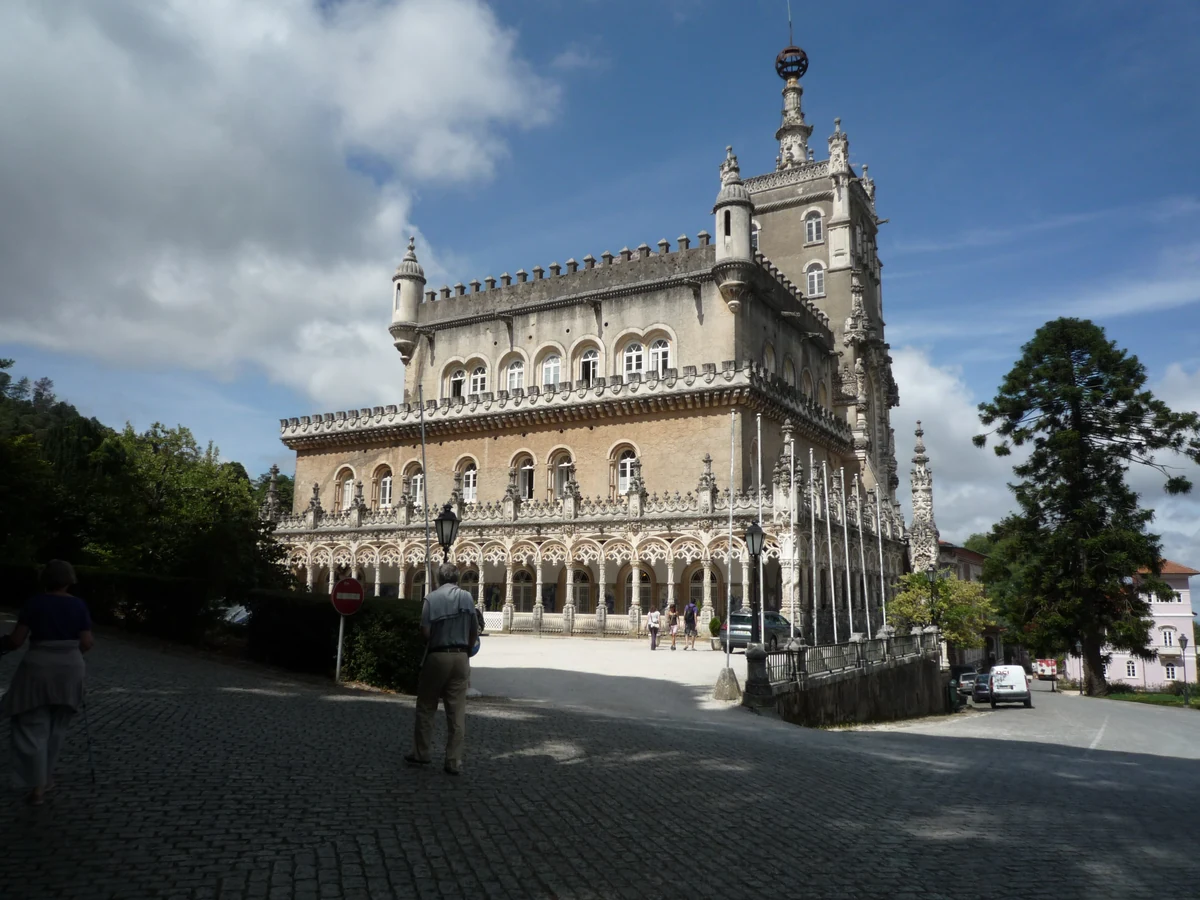
There are hotels that make a useful base for a journey, and others that become its centre of gravity. Palace Hotel Bussaco belongs in the second category. Near Luso, north of Coimbra, an exuberant palace rises from a wooded landscape of gardens, paths and fountains. Come for the architecture, then leave enough time for the forest. The most rewarding stay here may be the one with the least crowded itinerary.
A palace worth looking at slowly
Begin outside. Follow the changing outline of arches, balconies and carved stone before trying to take in the whole building. Bussaco’s neo-Manueline design revisits the ornamental language of Portugal’s sixteenth century, with references to Lisbon’s Belém Tower. Luigi Manini, both architect and theatre designer, gave the project its distinctive imagination. Other architects developed the ensemble, including Norte Júnior, responsible for the Casa dos Brasões.
The setting encourages a different kind of sightseeing: returning to a façade at another hour, noticing a detail above an entrance, allowing the building to reveal itself gradually. This is architecture that deserves more than a photograph on the way to somewhere else.
Portuguese art behind the doors
Inside, the decorative work makes the hotel a destination for anyone interested in Portuguese art. Jorge Colaço’s azulejo panels bring literary and historical subjects into the rooms and circulation spaces, including scenes associated with the Battle of Bussaco. Paintings, sculptural details and elaborate portals continue the conversation between architecture and national memory.
Look at the relationship between the surfaces rather than rushing from one celebrated object to another: the way tilework frames a staircase, or carved stone changes the character of a doorway. The pleasure lies in the accumulation of craftsmanship.
A royal chapter at the edge of change
The hotel’s own historical account records visits by King Carlos and Queen Amélia in August 1904. It also associates Manuel II and the French stage star Gaby Deslys with Bussaco in 1910, a connection repeated by the regional tourism authority. These accounts give the palace a human dimension, beyond its monumental silhouette.
A more consequential moment came on 27 September 1910, with the centenary commemorations of the Battle of Bussaco. The hotel identifies the occasion with the monarchy’s final official ceremony, shortly before the establishment of the Republic. It is a striking historical juxtaposition: a setting designed for ceremony standing at the threshold of political change.
The names in the guest book
Bussaco’s cultural history reaches well beyond royalty. In a 2024 TNews article, researcher Jorge Mangorrinha described consulting the hotel’s Livro de Ouro and reported an entry recording Agatha Christie’s visit on 4 July 1965. His account also identifies entries by singer Amália Rodrigues, actor Geraldine Chaplin, writer Manuel Alegre and President Mário Soares.
Together, those names bring music, cinema, literature and public life into the history of the hotel. For today’s visitor, they add another layer of interest to the rooms and corridors: a reminder of the very different lives that have crossed here.
Before the hotel, a place of retreat
The landscape’s story begins much earlier than the palace. Construction of the Carmelite convent began in 1628, and the religious community remained until the dissolution of the religious orders in 1834. In 1810, during the Peninsular War, Wellington used the convent as an operational base around the Battle of Bussaco. That episode belongs to the convent and surrounding landscape, decades before the hotel existed.
Knowing this changes the walk outside. The surviving religious fabric and the forest are part of the place’s identity, giving the palatial architecture a quieter, older context.
Let the forest set the pace
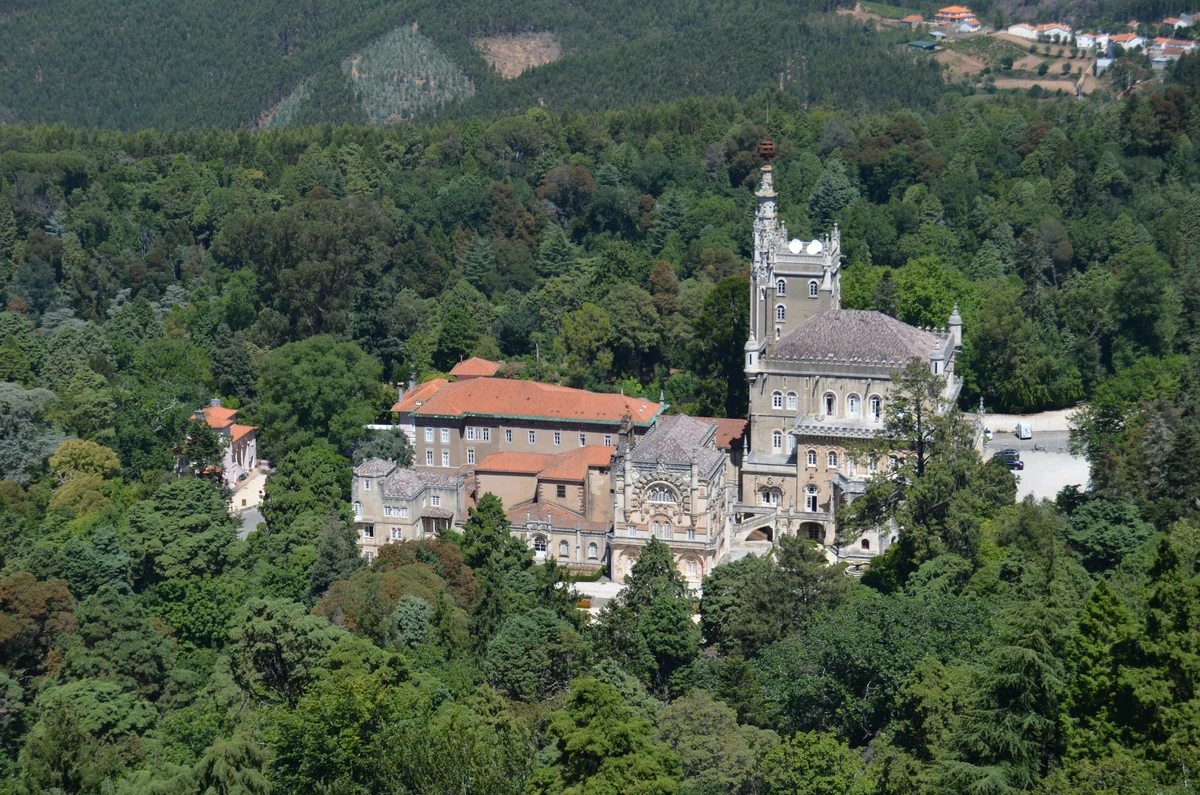
The surrounding national forest covers approximately 105 hectares. Within it, formal gardens give way to very different woodland scenes. The Fern Valley, laid out in 1887–1888, has avenues of tree ferns; around the palace, the garden offers a more composed foreground to the building.
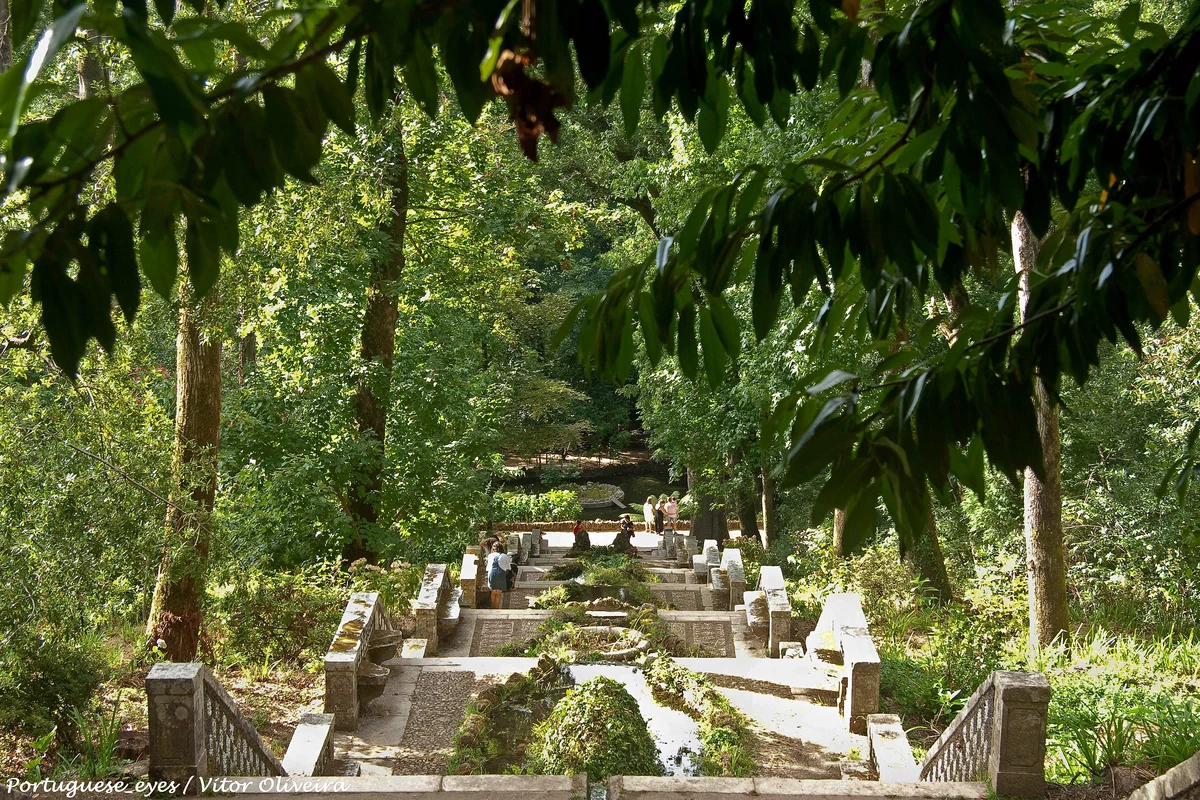
For a walk with a clear theme, the foundation’s Water Trail links fountains and water features, including Fonte Fria and the Fern Valley. Choose the route to suit the weather and your energy, allowing pauses rather than treating every landmark as a target. The terrain is hilly, so comfortable footwear and a check of current trail conditions make sense. A short, unhurried walk can be as satisfying as a longer circuit.
Make an evening of the hotel
There is a good reason to return from the forest with time to spare. The Mesa Real restaurant pairs Portuguese cooking with a richly decorated setting, including paintings inspired by Camões and an ornate ceiling. A meal can become part of the architectural experience, rather than a practical interruption to it. Check current menus and reserve directly if dining is central to your plans.
Bussaco also belongs to the wider story of Hotéis Alexandre Almeida. The group dates its foundation to 1917 and describes itself today as managed by the family’s third generation. That continuity is a meaningful part of a feature about Portuguese hospitality: buildings matter, and so does the tradition of welcoming people into them.
Our suggestion: give Bussaco two nights
For a first visit, we would allow two nights if the itinerary permits. Use the first afternoon for the palace and gardens, then devote the following morning to the forest. Keep a generous interval for lunch, reading or simply sitting, with dinner as the evening’s main appointment. Coimbra and the Bairrada region offer possibilities for extending the journey, but the hotel need not become a hurried stop between them.
Before booking, ask about the room category and outlook, access arrangements through the forest, and any mobility requirements. The appeal is specific: a historic setting, substantial decorative character and nature close at hand. For travellers drawn to those qualities, Bussaco offers the ingredients for a stay that feels distinctively Portuguese.
A researched heritage feature by BEST TRAVELS. Historical guest-book details are attributed to the published account cited below.
Sources
- Turismo de Portugal • REVIVE
- Palace Hotel Bussaco • architectural history
- Palace Hotel Bussaco • Portuguese history
- Turismo Região de Coimbra • Amélia de Orleães
- Jorge Mangorrinha • TNews, guest-book research • 2024-08-30
- Fundação Mata do Bussaco • Convento de Santa Cruz
- Fundação Mata do Bussaco • history
- Fundação Mata do Bussaco • forest landscape
- Fundação Mata do Bussaco • gardens and Fern Valley
- Fundação Mata do Bussaco • Water Trail
- Palace Hotel Bussaco • restaurants
- Hotéis Alexandre Almeida • official group website
- Palace Hotel Bussaco • location
Photo credits
- Palace Hotel Bussaco. Bli (https://commons.wikimedia.org/wiki/File:Bussaco_palace_hotel.jpg) • CC BY-SA 3.0 (https://creativecommons.org/licenses/by-sa/3.0/)
- The palace within Bussaco Forest. Pedro Nuno Caetano (https://commons.wikimedia.org/wiki/File:Bu%C3%A7aco_%287993715911%29.jpg) • CC BY 2.0 (https://creativecommons.org/licenses/by/2.0/)
- Palace and formal gardens. Pedro Nuno Caetano (https://commons.wikimedia.org/wiki/File:On_day_in_Bu%C3%A7aco_I_(49880459431).jpg) • CC BY 2.0 (https://creativecommons.org/licenses/by/2.0/)
- Fonte Fria in Bussaco Forest. Vitor Oliveira (https://commons.wikimedia.org/wiki/File:Fonte_Fria_-_Mata_do_Bussaco_-_Portugal_%2850331734307%29.jpg) • CC BY-SA 2.0 (https://creativecommons.org/licenses/by-sa/2.0/)